
Last updated on November 11, 2026 by Emma Collins
A radiator that is warm at the bottom and cold at the top is usually full of trapped air, and bleeding it takes about ten minutes. So how often should you bleed your radiators? Once a year, in early autumn before you switch the heating on properly, is enough for most homes. Bleeding means letting out the trapped air that stops hot water circulating, and it is one of the simplest jobs in home maintenance. If your heating still struggles after bleeding, the boiler itself may be the problem, so our guide to new boiler costs will help you weigh up a replacement.
Table of Contents
How Often Should You Bleed Radiators UK: The Short Answer
For most homes, bleeding your radiators once a year is enough. The best time is the start of autumn, before the heating season begins, so the system works properly from the first cold day. Bleeding a single radiator typically takes five to 10 minutes, including finding the bleed valve, letting the air out and closing the valve again, so the whole house is usually done in under an hour. You may need to bleed more often if your system is older, has visible leaks, or has recently had work done, such as new radiators being added. Air gets in whenever a system is drained and refilled, so always bleed the radiators after plumbing work.
Signs Your Radiators Need Bleeding
You do not need to guess when to bleed a radiator. The classic sign is cold spots at the top while the bottom is warm: air rises, so trapped air gathers at the top. Other signs include:
- Gurgling, bubbling or banging noises from radiators or pipework, as water struggles past pockets of air.
- Radiators slow to heat up, or never as warm as they used to be, even with the thermostat up.
- Uneven heating across rooms, with some radiators hot and others lukewarm.
- A radiator cold all over, which can mean trapped air in the pipework leading to it.
The simplest test is to run the heating for 10 to 15 minutes, then feel the top and bottom of each radiator. If the top is cooler, it needs bleeding; if the bottom is cold, that usually means sludge.
How to Bleed a Radiator Step by Step
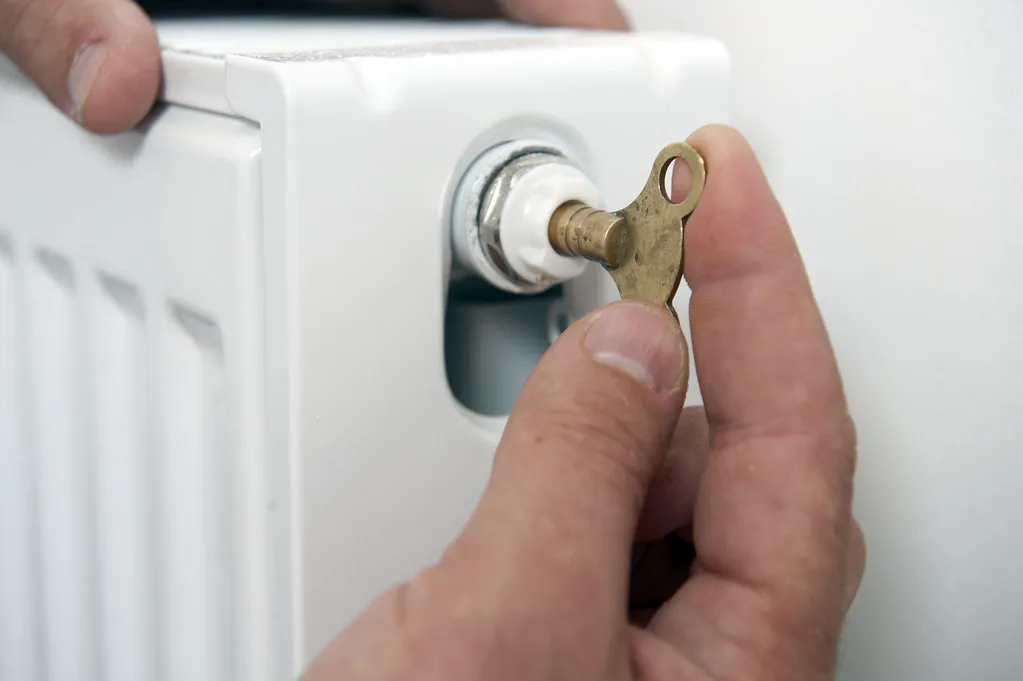
Bleeding a radiator is straightforward: you need only a bleed key and an old cloth. Work through the radiators one at a time, starting furthest from the boiler.
- Turn the heating off and let the radiators cool for at least 30 minutes. Never bleed a hot radiator, as the water inside is scalding.
- Find the bleed valve, a small square valve at the top corner, usually opposite the temperature valve.
- Hold the cloth under the valve and fit the bleed key. Turn it slowly anti-clockwise, about a quarter to half a turn.
- Listen for the hiss of escaping air. Keep the valve open until the hissing stops and water trickles out, then close it.
- Check the valve is closed firmly, but do not over-tighten it.
- Check the boiler pressure once finished, topping up if the gauge has fallen.
- Turn the heating back on and check each radiator warms up evenly.
If water sprays out at once with no hiss, that radiator did not need bleeding. For a fuller walkthrough, the guide from Hometree is a useful second opinion.
What to Do After Bleeding Your Radiators
Once you have bled the radiators, give the system a proper check. Turn the heating back on and let it run for 15 minutes, then feel each radiator again: they should all be warm from top to bottom, with no cold patches or gurgling. Check the boiler pressure gauge, as bleeding often drops the pressure a little. For most sealed systems the gauge should read 1 to 1.5 bar when the system is cold — your boiler manual will show the normal range for your model and how to top the system up through the filling loop. If the pressure keeps dropping after you top it up, that points to a leak, and you should call a heating engineer. A well-bled system runs more efficiently, which pairs nicely with good insulation: our guide to loft insulation costs explains a best-value way to keep heat in.
When Bleeding Will Not Fix the Problem
Bleeding only fixes trapped air, so it is worth knowing when the problem is something else. The table below is the quick version — feel the radiator first, then match the symptom.
| What the radiator feels like | Likely cause | What to do |
|---|---|---|
| Cold at the top, warm at the bottom | Trapped air | Bleed the radiator |
| Warm at the top, cold at the bottom | Sludge settled at the base | Needs a powerflush or chemical clean — bleeding will not move it |
| Cold all over while the rest of the house is warm | Stuck thermostatic valve, or air in the pipework | Try turning the valve fully on and off a few times; if that fails, call a heating engineer |
| Leaking from the valve or panel | Worn valve or damaged panel | Needs repair or replacement, not bleeding |
| Boiler making noises, losing pressure or switching itself off | A fault at the boiler | Get a Gas Safe registered engineer to look at it, and never open up a boiler yourself |
If a radiator is cold at the bottom after bleeding, that usually means sludge, the black magnetite debris formed by corrosion, has settled at the base. Bleeding cannot move it, and the radiator may need a powerflush, a professional clean of the whole system. If a radiator stays completely cold, the thermostatic valve may be stuck: try turning it fully on and off a few times. A radiator leaking from the valve or panel needs repair or replacement, not bleeding. Finally, if your boiler makes noises, loses pressure constantly or switches itself off, get a Gas Safe registered engineer to look at it, and never open up a boiler yourself.
Frequently Asked Questions
Do I need to bleed all my radiators, or just the cold one?
Just the one that needs it. Bleed any radiator with cold spots at the top or gurgling noises, and leave the rest alone. Doing the whole house once a year in autumn is good practice, but there is no need to bleed a radiator that heats evenly.
Should radiators be on or off when I bleed them?
Off, and cooled down. Turn the heating off and wait for the radiators to cool before you start, so you do not risk a scald. Once finished, turn the heating back on and check each radiator warms up evenly.
What happens if I bleed a radiator too often?
Bleeding a radiator that does not need it does no real harm, but it lets a little water out each time, which drops the system pressure. If the same radiator needs bleeding every few weeks, get the system checked for a leak.
Can I bleed a radiator without a bleed key?
Yes, in a pinch. Some modern bleed valves turn with a flat-head screwdriver, and a small adjustable spanner works on others. A proper bleed key costs very little, though, and is much easier to use.
Conclusion
Once a year, in early autumn before the heating season, is the rule for most homes, with extra bleeds whenever you notice cold spots at the top, gurgling noises, or radiators that are slow to warm up. It takes five to 10 minutes per radiator, needs only a bleed key and a cloth, and it keeps your heating running efficiently all winter. If bleeding does not fix the problem, or the same radiator keeps needing it, call a heating engineer, as the cause is likely sludge, a stuck valve or a leak. A radiator that is simply never quite warm enough, even when the system is healthy, may also be the wrong size.

Emma Collins is the editor of The Homely Way, a UK home and lifestyle magazine. She writes practical, plain-English guides on home improvement, cleaning, heating and saving money around the home — always with UK prices, UK products and real-world costs, and no jargon. When she is not writing, she is planning the next guide.
Pingback: How Much Does a New Boiler Cost UK 2026? Prices Explained